.png)
Ellsworth Kelly's 'Austin'
- Mar 31
- 3 min read
Updated: 6 days ago
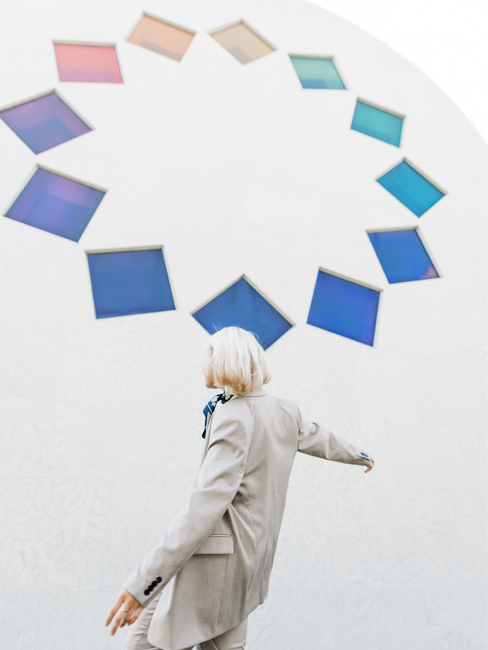
At the edge of the University of Texas at Austin campus, sits a small white building, filling in the landscape between brutalist educational infrastructure and the Blanton Museum. From the outside, it resembles a temple, stripped down to its bare form. Its curved ceilings and crisp white limestone, mirror a house taken off the Santorini coast and placed under religious aesthetics. Above its entrance, is a grid of nine colored windows. Each side of the building showcases a spectrum of colors through varied glass shapes: tilted squares or thin rectangles. This unassuming building is Ellsworth Kelly’s Austin.




Austin was originally designed as a commission for a television producer (Douglas S. Cramer) and one of their personal estates. However, the project fell through before anything more than 3D models were made. It took nearly 30 years before Simone Jamille Wicha, Blanton's director, became aware of the project and in a fateful turn worked with Ellsworth Kelly in some of his final days to approve what would become one of the University of Texas at Austin's most beloved buildings and Kelly’s final work.
Ellsworth Kelly’s Austin — I walked into it for the first time in the afternoon. Light poured through every window pane. Each window tinted the passing sun with a different color, transforming the snow-white walls within. Beams of red and blue and yellow vibrantly gleamed onto the closest surface, and the simplicity of the architecture moved my eyes to only that which the sunlight touched. I have never experienced color as vividly quiet until this space whispered rainbows before me.
Kelly, known for his minimalism in examining color and form, as an experience are especially highlighted in Austin. Across the piece's walls, light controls when and where color is present. Similar to the flittering of birds which Kelly often speaks to in developing his love for color, light flecks through Austin's windows, arriving and disappearing despite the viewer's desire for it to stay. It is this movement of light through the cistern inspired architecture which creates the grander realization that the space is void of religion. Where one might expect a crucifix, Austin presents a sole wooden column. Rather than spiritual portraits, we find small marble panels of Kelly’s black-and-white abstractions across the walls. The building's exterior bares the aesthetics of religion, but its interior directly juxtaposes this in color and only color.
This neutrality is one of the biggest statements the public can draw from the piece. What might one learn, when entering a space that presents you no opinion at all? More importantly, what can a university student gain inside of infrastructure that does not try to educate you? It seems obvious that the absence of symbols, figures, and devotion toward the divine, creates the presence of cognitive freedom. Yet, most presentations for educational neutrality, are still presentations, citing us sides of differing opinions or facts. The argument can be made that educational neutrality must involve all opinion, but perhaps true neutrality is void of opinion. If neutrality can be reached, I expect it to look something like Austin, a space very intentionally claiming nothing at all.
After being conceived decades ago, Kelly planned the completion of Austin during the last years of his life, reviewing any and all changes the piece had to undergo when considering how it would occupy its current home on campus. In the end he stated that he wanted people to be able to go and “rest your eyes, rest your mind.”
All the omissions of common symbols can be seen as intentional inclusion for neutrality— a true nondenominational monument free of judgment to all who visit it. The irony of Austin once being designed for a singular TV producer, whose purpose is to present stories to the world, seems like divine intervention itself.
Today Austin continues to shed light on bare walls. Its emptiness welcomes us to approach ourselves with fullness as there are no other opinions but our own presented to us. Its minimal use of color? A gentle reminder about the areas of life that exist between black-and-white. Austin, is exactly the addition a college campus needs, providing the ideal space to reflect on new perspectives with an open, unbiased mind. If you have the privilege of visiting I hope you too experience the small gift of lightness in life's contrasts, instilled by the intentions of its artist and creator.
References:
Miller, M.h. “Ellsworth Kelly's Temple for Light.” The New York Times, The New York Times, 8 Feb. 2018, www.nytimes.com/2018/02/08/t-magazine/ellsworth-kelly-austin-last-work.html.
“Visiting Austin – Austin's Blanton Museum of Art.” Austins Blanton Museum of Art, blantonmuseum.org/ellsworth-kellys-austin/.
“A Conversation with Ellsworth Kelly and Agnes Gund.” YouTube, NewYorkMakers, 6 Nov. 2013, www.youtube.com/watch?t=723&v=C88QEEXHp1o.